Watershed Center Crews Record Low Snowpack for March 2026
March brought dramatic snow loss in the Trinity Alps.
The California Cooperative Snow Survey (CCSS) program asked the Watershed Center (and all of its Statewide constituents) to conduct an extra snow survey in the middle of the month, in addition to the standard end of the month survey. The CCSS was observing an unusually prominent snowmelt event and wanted to study it. They were also concerned that all of the snow would melt before the final end of year survey, and these extra surveys would provide more information on how the melt was occurring.
Ben Letton, one of our surveyors at the Watershed Center, had this to say about the most recent March survey: "We were hoping to measure feet of snow at this time of the year but ended up only measuring inches of snow at Bear Basin and Red Rock snow courses. Unfortunately, [we saw] very little snow for the end of March.”
Surveyors had to use bulk sampling, which is a technique reserved for sampling when there is not enough snow in the tube at each station to break the tare on the scale. Surveyors are forced to collect samples across the course and combine them into a “bulk” sample that can be weighed.
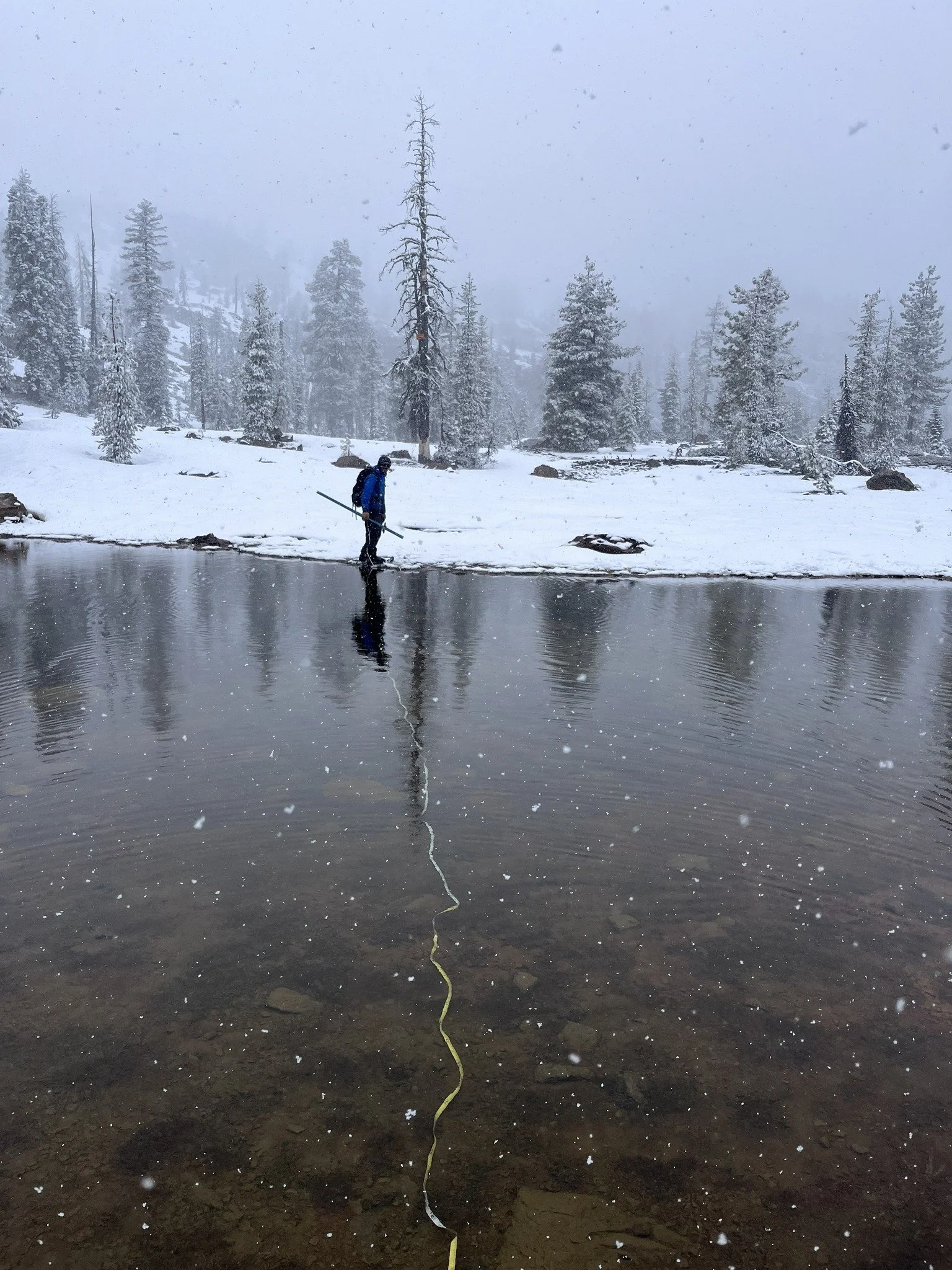
Large portions of Shimmy Lake were melted out during the March survey.
The two surveyors who covered the Shimmy Lake course encountered both dry spots and standing water. There was not enough snow to ski into any of the sites during this survey window and surveyors mainly hiked with some use of snowshoes.
Trinity County received relatively average amounts of precipitation in recent months, but most of it arrived as rain, not snow. Without a slowly melting snowpack to trickle down and feed mountain streams all summer long, we’re looking at the consequences of a low snowpack from every natural resource discipline. Fire danger immediately comes to mind. Dry and available fuels. Disconnected pools of water in local creeks making life harder for our fish friends and aquatic neighbors.
“In the 15 years I’ve been conducting snow surveys, we’ve measured six of the lowest recordings in the entire record,” stated Josh Smith, Watershed Stewardship Program Director at the Watershed Center. The snow courses the Watershed Center has measured at–Bear Basin, Red Rock Mountain, and Shimmy Lake–have been surveyed every year since 1946.
Maybe more important than the increasing rainfall and decreasing snowfall is the fact that the snowline where rain and snow meet seems to be rising. There is much less available land above 6,000 feet than there is at 5,000 feet, thus there is much less snow available to provide water later in the season.
Our decreasing snowpack is not unique to Trinity County; this trend has been observed all over the world.
The most proactive thing we can do is prepare for hotter and drier summers, and sometimes hotter and drier conditions in spring and autumn. To that end, our water storage and forbearance projects directly help priority streams keep water in the channel during the most arid months of the year. The strategic reduction of hazardous fuels around houses and application of beneficial fire around at-risk communities when conditions are favorable tangibly improves fire resilience and safety. Our work in restoring meadows (such as Corral Gulch or high mountain meadows) has the ability to store water in the ground which can help alleviate the missing snowpack melt water.
We can’t make more snow fall from the sky, but we can take direct action on the ground to better adapt to changing weather conditions.
Here are the results of the March 2026 snow surveys, with 2025 results in parentheses for comparison:
Bear Basin
Snow height - 8.5" (97")
Snow Water Equivalent - 4" (38.5")
Red Rock Mountain
Snow height - 3.5" (106")
SWE - 1" (48“)
Shimmy Lake
Snow height - 6.5" (108.5")
SWE - 4" (49.5")
You can learn more about our snow surveys here: www.thewatershedcenter.com/snow-surveys. If you would like to obtain a water tank array on your property, connect with Lesli Mounivong via email: lesli@thewatershedcenter.com. If you wish to make a donation to our stewardship work, click HERE.
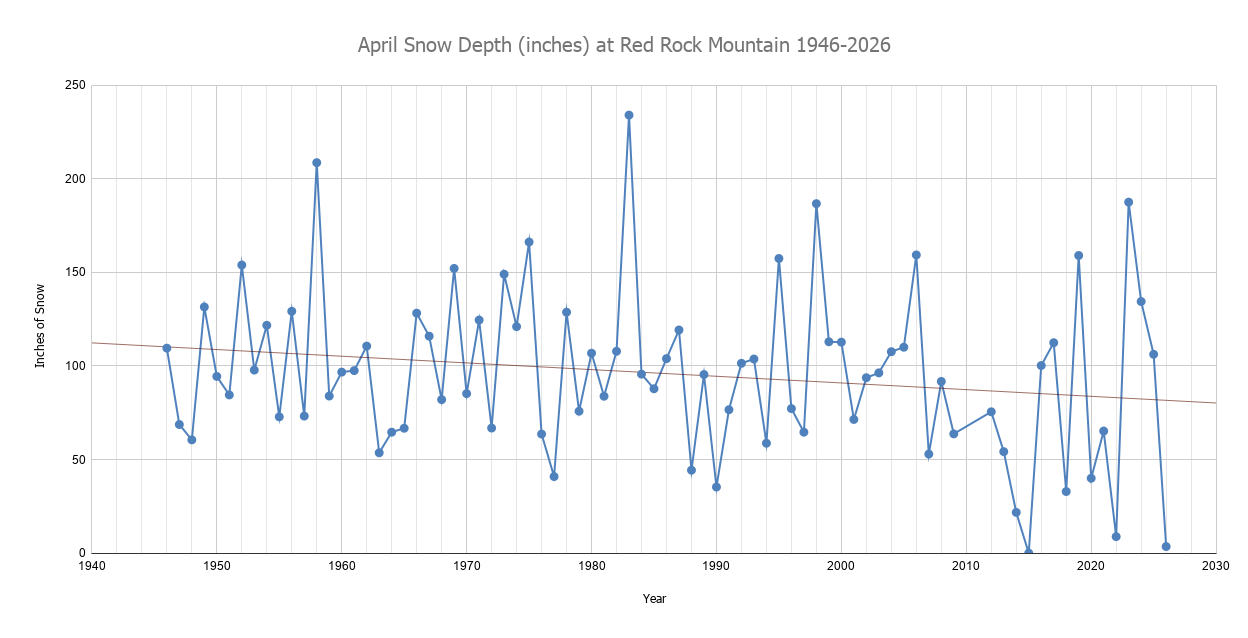
Eighty years of snowpack measurements from 1946 to 2026.